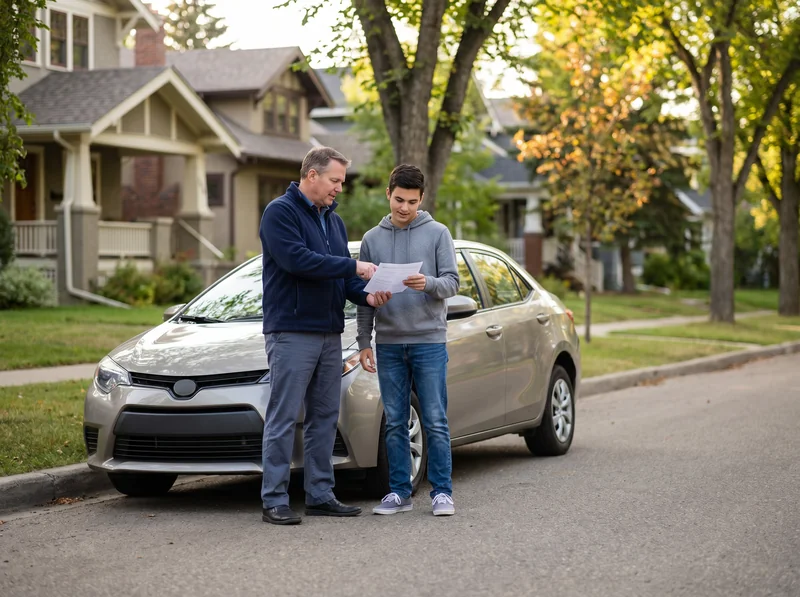
Defensive driving is not a specific manoeuvre — it is a mindset. It means driving in a way that anticipates hazards before they develop, manages risk proactively, and maintains a safety margin that gives you time to respond when other drivers, pedestrians, or road conditions create unexpected situations. In 2026, with distracted driving rates higher than ever and Edmonton roads busier than at any point in the city's history, defensive driving techniques are not optional for safe drivers — they are essential.
The Foundation: Space Management
Every defensive driving principle connects to one fundamental concept: maintaining space. Space buys you time. Time allows you to identify hazards. Time allows you to react safely. When you reduce your following distance, you eliminate your response buffer — not just for the car ahead of you, but for everything that car might react to that you cannot yet see.
The two-second rule gives you a minimum following distance on dry roads at urban speeds: pick a fixed point, watch the car ahead pass it, and count two full seconds before you pass the same point. On wet roads, extend to four seconds. On snow or ice, extend to six seconds or more. In Edmonton's winters, doubling or tripling your normal following distance is not overcaution — it is accurate physics.
Scan Far Ahead — Not Just the Car in Front
Inexperienced drivers fix their eyes on the vehicle directly ahead. Experienced defensive drivers scan 12–15 seconds ahead of their position — roughly a city block in urban traffic, or the visible road ahead on a highway. This forward scanning gives you early warning of slowing traffic, obstacles, pedestrians entering the road, or changing signal patterns before they affect your immediate situation.
Practice lifting your gaze beyond the car in front and identifying what is happening several vehicles ahead. Your peripheral vision handles the car in front — your active attention should be focused further down the road.
Identify Escape Routes
At any point while driving, you should be able to answer: "If something goes wrong in the next two seconds, where do I go?" This is the escape route mindset. In traffic, your escape route might be the shoulder, the adjacent lane (after a shoulder check), or simply more stopping distance. In heavy traffic where lanes are blocked, identifying your escape route means staying back far enough to have options.
This technique is particularly valuable at intersections — arguably the most dangerous places on any road. Before entering an intersection on a green light, scan left and right for late-runners. Have a mental plan for where you would steer if someone ran the red before you could stop.
Manage Your Following Distance — Even When Pressured
One of the hardest defensive driving habits to maintain is proper following distance when a driver behind you is tailgating. The temptation is to speed up or close your gap to the car ahead to "justify" being further back from the tailgater. Resist this. Increasing your speed to appease a tailgater puts you closer to the hazard in front and removes your own response time.
Instead, if you have a tailgater, increase your following distance to the car ahead — this gives you more time to brake gradually if needed, reducing the chance the tailgater behind you will rear-end you. If the tailgating continues, safely allow them to pass.
Eliminate Distractions Completely
In 2026, distracted driving has surpassed impaired driving as the leading cause of collision fatalities in Alberta. Using a handheld phone while driving is illegal in Alberta and carries significant demerit points and fines. But distraction is broader than phones: adjusting navigation, eating, reaching for items in the back seat, and even intense conversations with passengers all reduce your hazard detection ability.
Defensive driving means giving the road your full attention. Set your navigation before you leave. Put your phone in the centre console or on silent. Finish eating before you drive. If you need to make a call, use a properly mounted hands-free system — and even then, understand that cognitive distraction (thinking about the call) reduces your hazard detection regardless of whether your hands are on the wheel.
Anticipate, Do Not Just React
The difference between a reactive driver and a defensive driver is anticipation. Reactive drivers respond to what is happening. Defensive drivers predict what is likely to happen based on cues in their environment and position themselves to avoid the problem before it develops.
Practical examples: When you see a ball roll into the road, slow down immediately — a child is likely to follow. When a large truck is merging toward your lane, ease back even if you have right of way — being right is not worth a collision. When you see brake lights four cars ahead, start braking now rather than when the car directly ahead brakes. Anticipation is the most powerful defensive driving tool available.
Adjust to Conditions — Every Time
Posted speed limits are designed for ideal conditions. Rain, fog, snow, ice, construction, and heavy traffic are not ideal conditions. Defensive driving means continuously adjusting your speed, following distance, and positioning based on actual conditions — not just posted limits.
In Edmonton's winters, this means reducing highway speeds significantly below the posted limit when roads are snow-covered or icy. Black ice — the near-invisible coating of ice that forms on bridges, overpasses, and shaded road sections — can cause immediate loss of control at speeds that would be completely safe on dry pavement. When temperatures are near freezing and roads are wet, treat every bridge and overpass as potentially icy.
Use the SIPDE Method
Professional drivers and advanced driver education programs use the SIPDE method as a systematic approach to managing traffic: Scan the environment, Identify potential hazards, Predict how the hazard might develop, Decide on a course of action, Execute the decision smoothly. This framework turns defensive driving from a vague intention into a repeatable process you can apply consciously until it becomes automatic.
New drivers benefit enormously from making SIPDE explicit during practice: "I see a car waiting to turn left — I predict they might pull out before I pass — I will move slightly right and cover my brake." Speaking these predictions out loud during early lessons helps build the hazard-identification habit that is the foundation of truly safe driving.
Practice These Techniques From Day One
Defensive driving habits are most effectively built during initial driver training — before reactive, overconfident habits have a chance to develop. At Arrow Driving School Edmonton, our certified instructors teach defensive driving techniques as part of every Standard Course and More Road Time package. Our goal is not just to get you through your road test — it is to develop the habits that keep you safe for life.
Book your driving lessons today or call us at (780) 721-8282. Available 7 days a week across Edmonton, Sherwood Park, Beaumont, Leduc, and St. Albert.
Also read: Winter Driving Tips for New Drivers in Alberta — how defensive driving applies specifically to Edmonton's winter conditions.
Ready to Start Your Driving Journey in Edmonton?
Arrow Driving School has helped 8,000+ Edmonton students pass their road test. Certified instructors. Free pick-up. 7 days a week.